
I know which climb
will break you.
Not “somewhere in the second half”. On a specific segment, at a specific hour — from your own runs, the climb profile, and how fast your form fades. On a 20 km race in the Beskids just like on a hundred.
From a vertical kilometer to a mountain hundred — if you run trails, this is for you.
ŁUT 150 forecast: 30:53. Result: [hh:mm]. Zobacz analizę →
14 days free · card at signup, nothing charged during the trial · cancel any time
App Store Google Play or in your browser, nothing to install
Proof · ŁUT 150
The number came before the race, not after
[TEKST TOMKA: 2–3 zdania — gdzie model trafił, gdzie się pomylił i dlaczego.]
How it works
Three steps. The rest runs itself.
1. Connect your watch
Once, no password and no token pasting. From then on UltraFlow pulls your HRV, sleep, load and power by itself.
Suunto — direct integration, approved for production. Garmin, Coros, Polar — through Runalyze (their Supporter plan required). Apple Health — sleep and resting heart rate at no extra cost, but HRV does not come through this route, so readiness cannot be computed from it. Your own FIT/GPX file — any watch, no integration.
2. One decision every morning
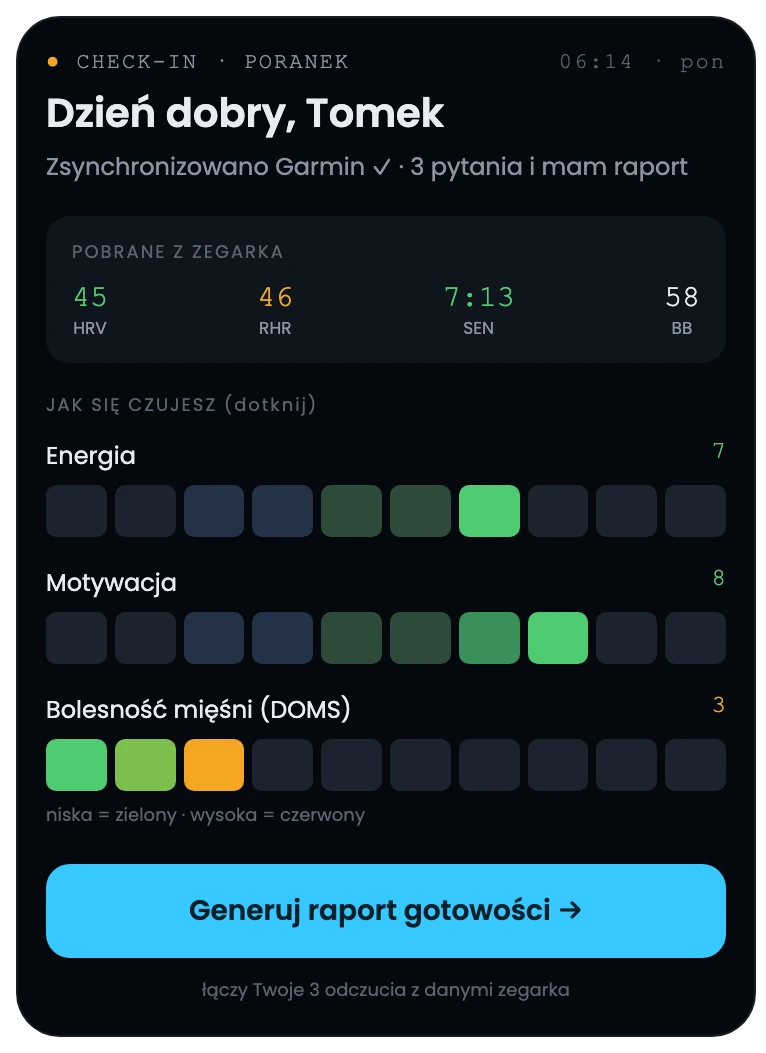
Train, ease off or rest — from your HRV, sleep, load and a ten-second check-in. Never at a fixed hour: when your watch has synced the night.
3. Before the race: a route plan
Upload the GPX of your race and get an execution plan: power and pace segment by segment, run/hike calls, how much water and food to carry.
Day to day
One decision every morning
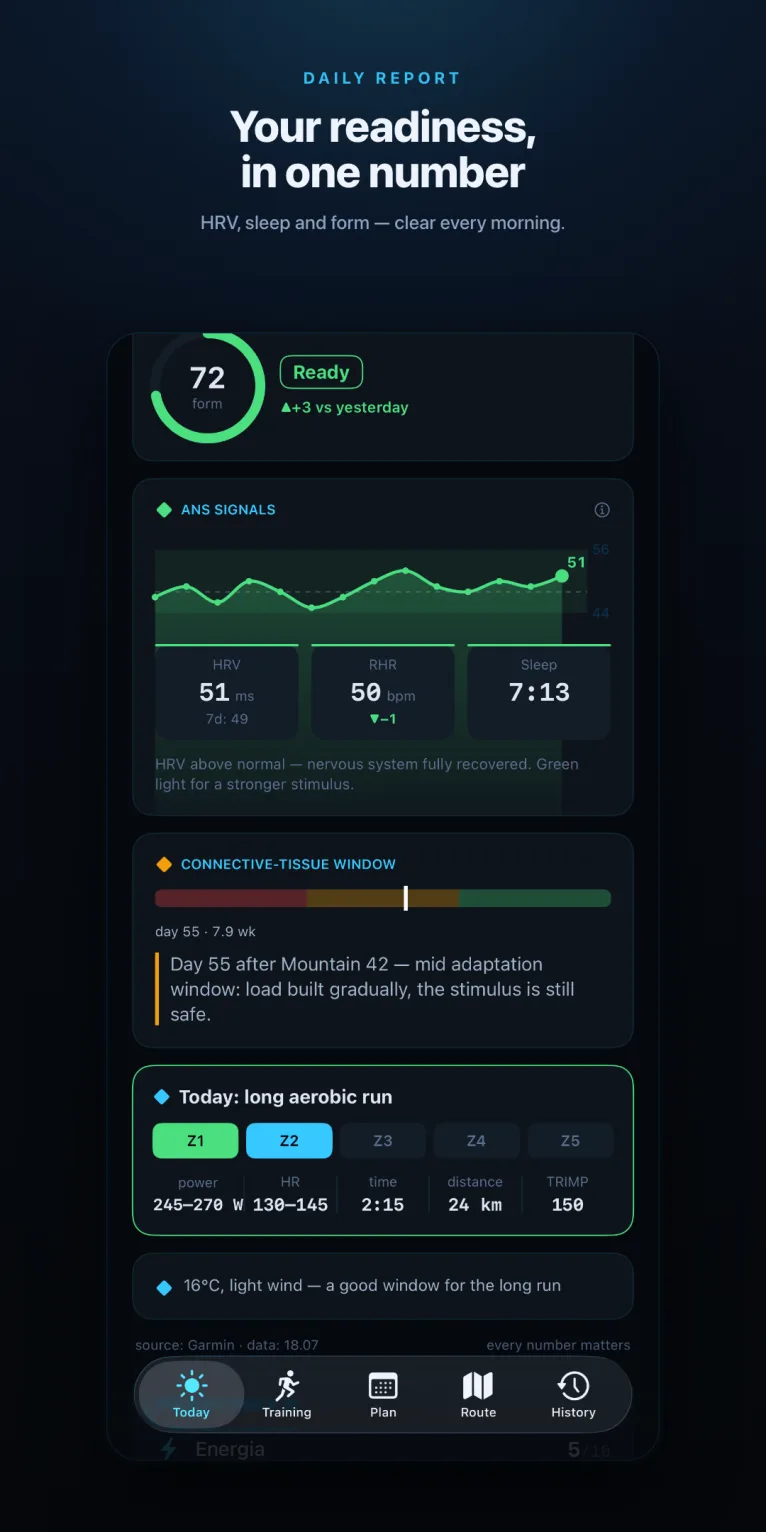
Train, ease off or rest — from your HRV, your load and how you actually feel. In the evening, a review of what you did.
sample data
Form of the Day — a session, not a slogan
HRV, sleep and a ten-second check-in in a single answer: train, ease off or rest. With a concrete session — not “easy run” but HR 130–140, 40 min, forest trail. After your run it is reviewed automatically.
A plan that follows you
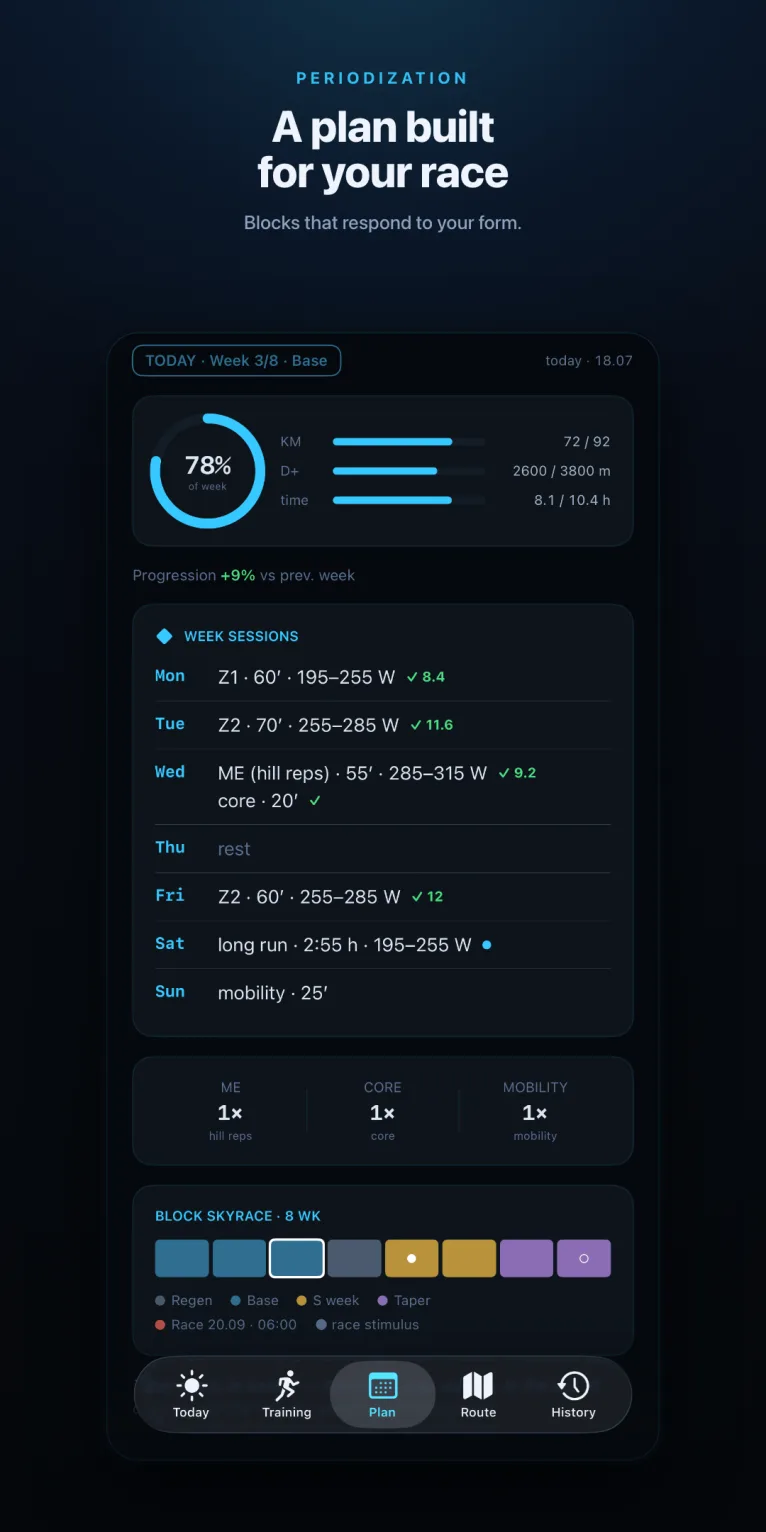
Give it your race and UltraFlow lays out the whole road: recovery, base, race-specific weeks, taper. Computed by a deterministic engine with a cited rule, never by AI narrative. And readiness has a veto: the plan proposes the day, Form of the Day can downgrade it. You always see where you are and where it leads.
Strength, core and mobility — in the plan, not implied
Running is not the only thing holding you together. The plan carries core sessions and mobility 3× a week through the whole block — with a cited rule, exactly like the runs. In the evening you tick off what you did and add stress from outside sport; both count towards your load instead of vanishing.
Overload protection
Acute-to-chronic load ratio and training monotony catch overload before you feel it. After a long ultra, tendons and ligaments rebuild more slowly than HRV recovers — a good HRV will not talk you into loading tissue that is not ready.
Flagship feature · Spatial analysis · Race Ultra Planner
A route built for your race
The plan tells you how to train week to week. The Race Planner tells you what the start itself demands — upload the route and UltraFlow reads its climbs, gradients and technicality, then shapes your preparation around its real demands. Not for "running in general." For this race.
Spatial route analysis
Just upload the route — it reads elevation and gradient from your GPX track, and splits the course into run and hike sections. You pick the surface type; the planner prices the route against it.
Adapts to your style
Your CP, power zones, how you pace climbs and descents, your race history — the plan bends to how you actually run, not a population average. The longer you use it, the better it fits.
Race-day pacing plan
From the route's real demands you get an execution plan for race day: power and pace targets segment by segment, run-vs-hike calls, where to push and where to hold back.
Weather-aware
The race-day forecast folds into the plan: electrolytes and a heat strategy when it's hot, layering and thermal comfort when it's freezing. The mountains turn fast — the plan accounts for it.
The pack on your back. The planner weighs it like no one else.
Carried load costs you on every climb — in the model, time is directly proportional to the mass you carry, so water you don't need turns into lost minutes. The planner tells you how much to carry on each leg. Mandatory kit stays untouched: it trims only the surplus, never safety.
For race day you get a printable race card — segments, power and pace targets, water and food for each aid station. A slip of paper for your vest pocket, because at hour 30 nobody scrolls an app.
Who built this
Built by an ultra runner
Tested every morning
"I have all the data. I just needed something that could tell me what it means — in the morning, before coffee."
I'm Tomasz — UESCA-certified ultra coach, firefighter, GIS analyst. I use UltraFlow on my own data every day. I am user #0. The product doesn't ship a feature until it survives a real training week.
📧 write to me · 🌐 ultraflow.run
Reviews
From the trail
„With the Planner I prepared pacing and fuelling for my first mountain race. It combined my strength sessions with running and showed me when to hit the brakes and go for full recovery. UltraFlow doesn't read tea leaves, it bases its analysis on hard data.”
 Trail runner
„What I value most is tracking cumulative fatigue and connective-tissue recovery — I had never monitored either before. The assessment looks at several days in a row rather than a single morning, so I can see that how ready I feel doesn't always match how recovered I actually am. Before UTMB, after long sessions I thought I needed more rest, and the app showed I could keep going with the plan.”
 Ultra runner
Pricing
One price
- Training plan for your race — full periodisation
- GIS-grade route analysis with a race-day pacing plan
- Daily morning report
- Overload signals: A:C load ratio and training monotony
- Daily Readiness
14 days free, then a monthly subscription you can cancel anytime. Card required at signup; first charge after the trial.
The morning call a coach would make — at the price of an app, not a coach.
FAQ
Everything you'd ask before starting
Which watch works?
Suunto — direct integration with the full picture: sleep with phases, overnight HRV, resting heart rate and every workout sync automatically. Garmin, Coros, Polar and others connect through Runalyze — you link your watch to Runalyze and click “Connect via Runalyze” in the app (my official OAuth client, requires the Supporter plan; you never share a password). If you have a Garmin and an iPhone, the app reads sleep and resting heart rate from Apple Health — no Runalyze needed; HRV does not come that way, so I won't judge readiness either. And with any watch you can already upload FIT/GPX files — every workout gets the full analysis. ⚠ Files alone carry no HRV, sleep or resting heart rate, so on that path I won't judge your readiness or hold you back from a hard session on a bad day — you get workout analysis, load and the plan.
I have a Stryd power meter — how do I get watts?
Stryd stores running power inside the full activity file in a way a standard watch connection doesn't pass along — so you'll get heart rate, pace and load, but not the watts. To get Stryd power, connect through Runalyze (an active Runalyze subscription required): Runalyze reads the whole activity file and forwards Stryd's power to UltraFlow. Short version: for Stryd watts, use the Runalyze connection.
How much does it cost?
€29/month (129 zł in Poland), billed monthly, cancel anytime.
Is there a free trial?
Yes — 14 days free. You enter your card at signup, nothing is charged during the trial, and you can cancel any time before it ends. After that it is 129 zł a month.
Is this medical advice?
No — a training tool, not medical advice. For health matters, see a doctor.
What data do you access?
Activity, HRV, sleep and load — only for your reports. I never sell them. Servers in the EU (Hetzner, Germany); the wording of the report is generated by Claude API (Anthropic, USA), which receives a minimised context without your identifying data — details in the Privacy Policy.
Running on data,
not on hope
Subscribe and start today. Suunto connects directly; Garmin, Coros and Polar via Runalyze (Supporter plan required) — or upload FIT files, without the readiness verdict.
14 days free · card at signup, no charge during the trial · cancel anytime
Not ready to subscribe yet? Get launch news — Suunto connects directly, Garmin, Coros and Polar via Runalyze, and any watch works through FIT/GPX upload (no overnight data, so no readiness verdict).
Double opt-in. Unsubscribe anytime. Prywatność